From Invisible to Inevitable: How Strategic Content by Varnan generated 6000+ GitHub Stars
Mon Dec 01 2025
TL;DR
- Challenge: Three technically sophisticated open-source projects with zero visibility in saturated developer markets
- Solution: Strategic video content engineered to reach qualified technical audiences at scale
- Results:
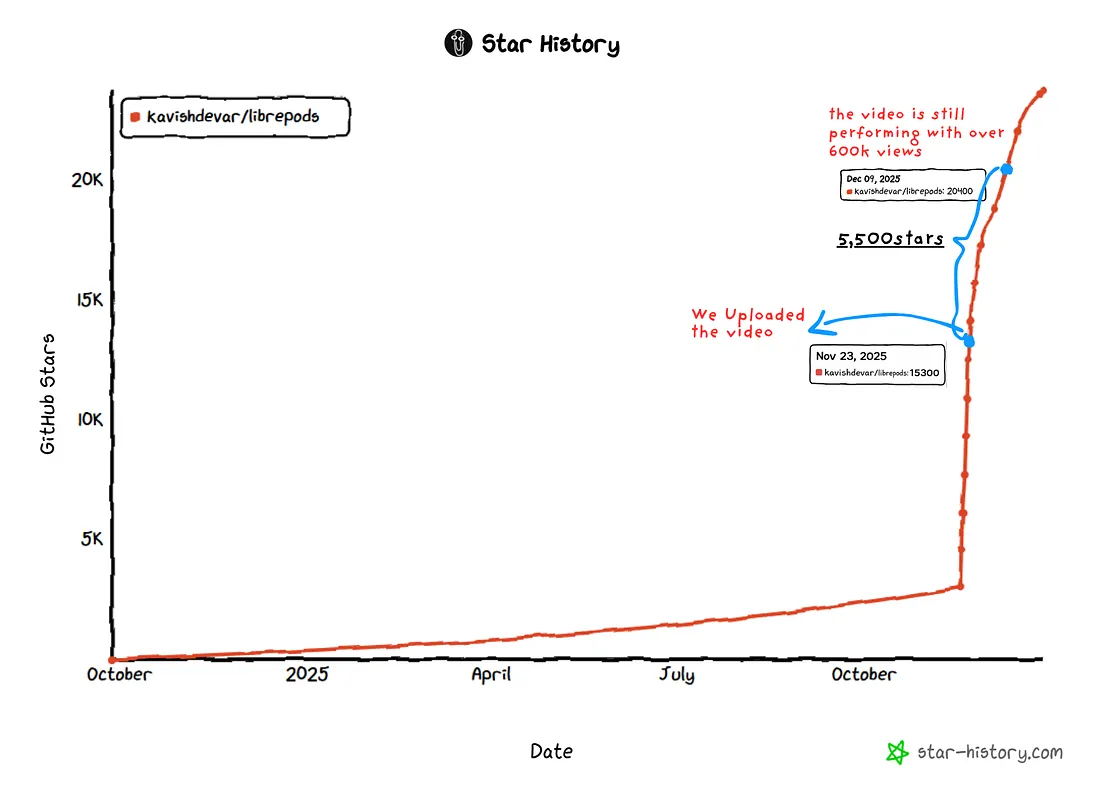
- LibrePods: 5500+ stars in 29 days from 600K views + major tech press coverage
- CraftGPT: 180+ stars generated from 343K views
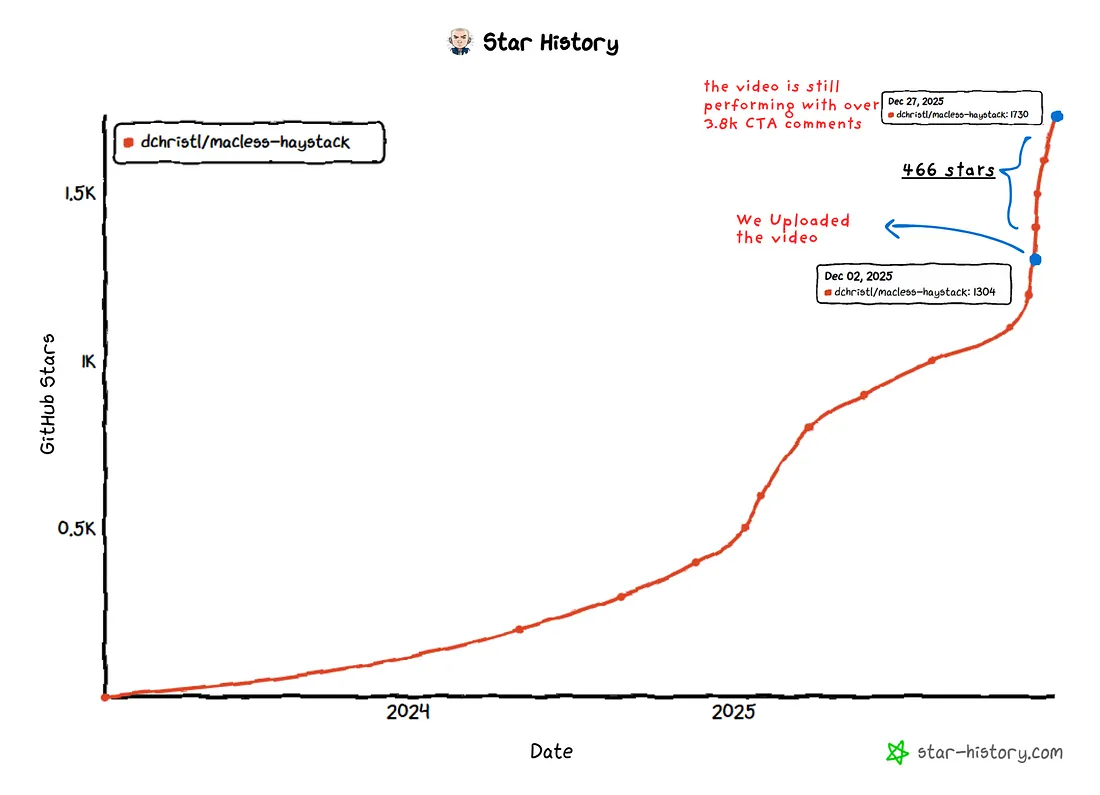
- Macless-Haystack: 450+ stars in 3 weeks from 500K views
- Total Impact: 6000+ GitHub stars generated, multiple tech publications covering projects, measurable community activation
- Investment: Strategic video content with multi-platform distribution and solid repurposing strategy
The Universal Problem: Great Code, Zero Distribution
You’ve shipped something genuinely innovative. Your code is production-ready. Your architecture is elegant. Your documentation is comprehensive.
Nobody knows you exist.
This isn’t a hypothetical scenario. This is the reality for 99% of open-source projects and developer tools. The gap between “technical excellence” and “market visibility” isn’t just wide, it’s a reality that swallows most projects before they reach their full potential.
Traditional developer marketing doesn’t work:
- Paid ads burn cash without qualified conversions
- Cold outreach gets ignored or filtered
- Generic “content marketing” drowns in noise
- Product Hunt launches spike for 48 hours, then die
The real question: If you build something developers need, how do you ensure developers actually discover it?
Three Projects. Three Videos. 6,000+ GitHub Stars.
Between October and December 2024, we ran a systematic experiment across three open-source projects. Each had genuine technical merit. Each had minimal visibility. Each needed a distribution strategy that actually worked.
We engineered content specifically designed to reach qualified technical audiences. Then we measured everything.
The results weren’t incremental improvements. They were transformational.
Case Study 1: LibrePods
The Product
Open-source Android and Linux application that reverse-engineers Apple’s proprietary AirPods protocols, unlocking iPhone-exclusive features on non-Apple devices.
Technical Sophistication:
- Reverse-engineered Bluetooth protocols Apple keeps locked to their ecosystem
- Implements noise control modes, transparency mode, ear detection, hearing aid features
- Created by a 15-year-old developer from Gurugram, India
- Requires rooted Android devices with Xposed framework (legitimate technical barrier)
Target Audience: Android power users, Linux enthusiasts, hardware hackers, developers interested in Bluetooth protocol reverse-engineering, AirPods owners frustrated with Apple’s ecosystem lock-in.
The Problem
Despite having a functional product and legitimate technical innovation, LibrePods faced critical visibility challenges:
- Discovery Gap: Users searching “AirPods Android” found commercial apps or basic Bluetooth tools, not a sophisticated reverse-engineering project
- Legitimacy Barrier: Open-source hardware hacking projects often face skepticism “Does this actually work?”
- Adoption Friction: Technical requirements (root access, Xposed framework) meant the project needed qualified users who understood the value proposition
The Stakes: Without visibility, even groundbreaking reverse-engineering work remains niche. The project needed mass-market awareness while maintaining technical credibility.
Our Approach
Positioning Strategy: We positioned LibrePods as a human story showing how a “15-year-old beats Apple and get AirPods features they won’t give you”
Content Strategy: Multi-platform video demonstrating:
- Screen recordings showing actual noise control mode switching
- Live demonstration of ear detection and transparency mode
- Battery status popups matching Apple’s UI
- Honest discussion of technical requirements (root + Xposed)
Distribution: Posted to Instagram and YouTube targeting Android power users, hardware hackers, and developers interested in Bluetooth protocol reverse-engineering.
The Results
Quantitative Metrics:
- December 22, 2024: Addition of 5500+ new stars in 29 days
- Video Performance: 600,000+ combined views (Instagram + YouTube)
- Engagement: 1,500+ comments across platforms
Media Amplification: We didn’t pitch journalists. The video demonstrated such clear technical merit that tech reporters found it themselves and wrote unprompted coverage, triggering a ton of secondary sharing across blogs, forums, and developer communities. Here are a few:
- 9to5Mac: “AirPods Pro user found way to unlock iPhone-exclusive features on Android”
- Android Authority: “This free app finally lets your AirPods Pro play nice with Android phones”
- Pocket-lint: “This app makes AirPods work great on Android”
- Digit India: “Gurugram school student builds open-source app… to bring full AirPods features to Android users worldwide”
Qualitative Outcomes:
- Contributors submitting PRs for new features and protocol improvements
- Users creating installation guides in multiple languages
- Media coverage attracted corporate sponsorship interest
- Tech press validation converted skeptical users into active community members
- Search ranking improved for “AirPods Android” queries
Case Study 2: CraftGPT
The Product
A small language model built entirely in Minecraft using vanilla redstone mechanics. No mods. No plugins. Pure computational engineering inside a game environment.
Technical Sophistication: The project implements actual neural network architecture using Minecraft’s redstone logic gates. It’s not a toy, it’s a legitimate demonstration of computational theory applied in an unexpected medium.
Target Audience: Computer science enthusiasts, ML engineers interested in foundational concepts, educators teaching neural network architecture, Minecraft technical community.
The Problem
CraftGPT existed in complete obscurity. Despite being featured on specialized forums, it had:
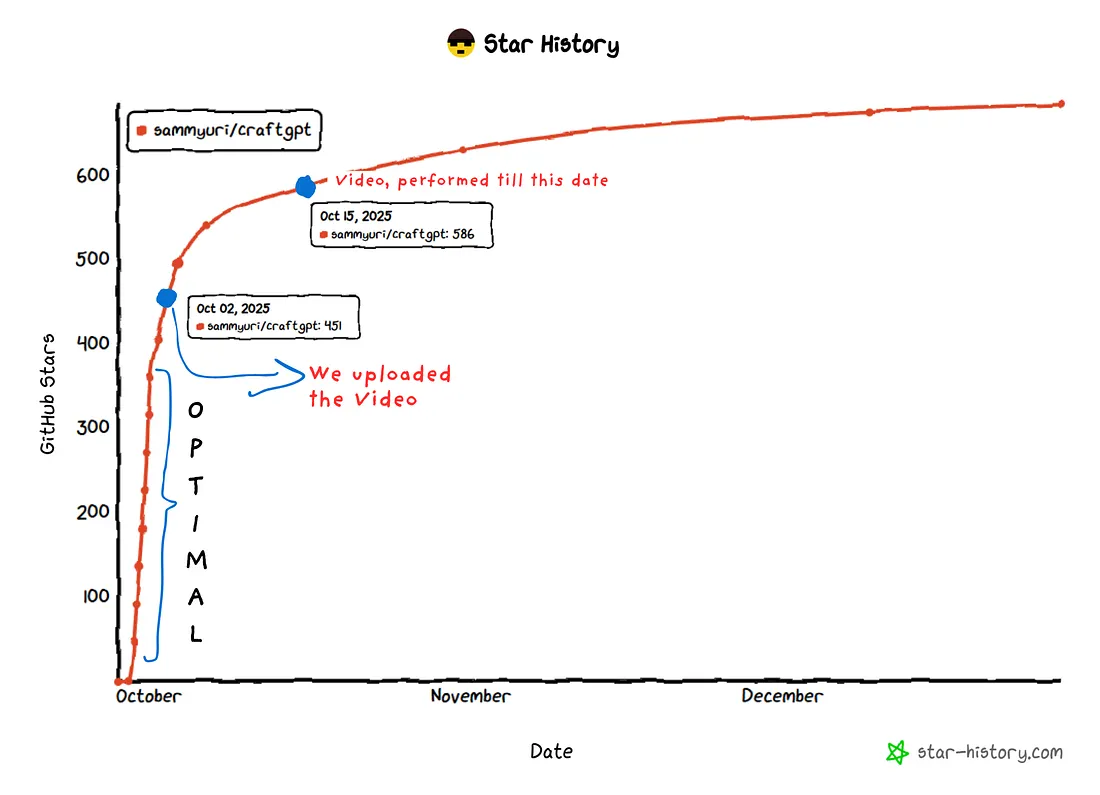
- 451 GitHub stars (October 2, 2024)
- Minimal community engagement
- No mainstream visibility
- No clear distribution strategy
The Trap: The project appealed to a narrow intersection of audiences (ML practitioners + Minecraft enthusiasts), making traditional discovery mechanisms ineffective.
Our Approach
Positioning Strategy: We didn’t position CraftGPT in fancy terms as “computational theory made tangible.” We positioned it simply as “AI in Minecraft”
Content Strategy: Single Instagram video + Youtube Reposting demonstrating:
- The actual redstone architecture implementing neural network layers
- Real-time token generation in vanilla Minecraft
- The educational value: understanding LLMs by building one in constraints
Distribution: Posted to Instagram and reposted to Youtube targeting developers interested in intersection of ML fundamentals, Gaming and Technical Education.
The Results
Quantitative Metrics:
- October 31, 2024: 631 stars (180 new stars in 29 days = 40% growth)
- Current Status: 684 stars (233 total stars generated = 51.6% growth)
- Video Performance: 343,000+ Instagram views
- Engagement: ~500 comments from qualified developers
Qualitative Outcomes:
- Developers explicitly citing the video as their discovery mechanism
- Increased project contributions and issue discussions
- Cross-platform sharing in ML education communities
- Educational institutions reaching out for classroom demonstrations
Case Study 3: Macless-Haystack
The Product
Open-source project enabling custom AirTag-like tracking devices using Apple’s Find My network without needing a Mac.
Technical Sophistication:
- Reverse-engineers Apple’s Find My network protocols
- Supports different chipsets for DIY tracking devices
- Provides Android app and web frontend for tracking
Target Audience: Hardware hackers, privacy-conscious users, IoT developers, makers building custom tracking devices, developers curious about Apple’s Find My network.
The Problem
Despite solving a genuine technical problem (accessing Find My without Apple hardware), Macless-Haystack faced critical barriers:
- Use Case Clarity: Potential users didn’t immediately understand why they’d want this
- Technical Complexity: The setup process intimidated non-expert users
- Competitive Noise: OpenHaystack and similar projects created confusion
- Trust Barrier: “Does this actually work with Apple’s network?”
The Market Reality: The intersection of “hardware hackers” + “Apple ecosystem users” + “DIY tracking needs” was too narrow for organic discovery.
Our Approach
Positioning Strategy We repositioned Macless-Haystack from “technical curiosity” to “practical privacy tool”:
Core Narrative: Build your own AirTags for $3 instead of $29, track anything you want, no Apple device required, full control over your data.
Key Value Propositions:
- Cost: Chipset cost $3–5 vs. $29 AirTags
- Privacy: Your tracking data, your control
- Customization: Track anything (bikes, drones, luggage, pets)
- Independence: No Mac/iPhone required to set up or manage
Target Communities:
- Hardware hacking forums (Reddit:
r/esp32,r/arduino) - Privacy-focused communities
- Maker spaces and DIY electronics groups
- Drone and RC hobbyist communities
The Results
Quantitative Metrics:
- Video Upload: December 2, 2024
- Current Status: 1,666 stars (466 new stars in ~3 weeks = 38.8% growth)
- Video Performance: 500,000+ combined views (Instagram + YouTube)
- Engagement: 3,500+ comments asking technical questions
Qualitative Outcomes:
- Hardware enthusiasts sharing their custom builds
- Increased issue reports (leading to bug fixes)
- Feature requests from real-world use cases
- Documentation improvements from community
- Educational institutions using it for teaching
The project went from “obscure technical experiment” to “definitive open-source solution for DIY tracking” in three weeks.
The Pattern: What Actually Drives Developer Adoption
After analyzing these three case studies (plus dozens of others in our portfolio), we’ve identified the exact formula that converts views into GitHub stars, community activation, and sustained project growth.
1. Technical Credibility Through Infotainment
We don’t create promotional content. We create technical analysis that developers actually want to watch.
- Demonstrate Real Value
- Explain the Technology
- Maintain Entertainment Value
- Be Honest About Limitations
The Result: Developers share content that teaches them something valuable. Educational value drives organic reach.
2. Video Optimization for Developer Audiences
- Algorithm favors high engagement (comments = distribution boost)
- Short-form forces clarity (60–90 seconds to demonstrate value)
- Visual medium perfect for product demonstrations
3. The Multiplication Effect: Content → Coverage → Legitimacy
Here’s what most founders miss: One piece of high-quality content doesn’t just generate views. It triggers a cascade.
The Cascade Pattern:
- Phase 1: Initial Video Release
- Phase 2: Community Sharing
- Phase 3: Media Pickup
- Phase 4: Search Optimization
- Phase 5: Sustained Growth
Our Guarantee: 90 Days or Free
We work exclusively with AI and developer tool companies. Our process:
Month 1: Positioning
- Deep market and competitor signal mapping
- Founder-led positioning and narrative workshop
- Clear messaging hierarchy and value propositions
- High-signal customer interviews to validate demand
Month 2: Launching and Testing- Doing whatever’s needed
- Technical content built to rank and compound on Google
- Product-led assets (templates, tools, interactive demos)
- Founder thought leadership designed for LinkedIn distribution
- Structured launch sequences for major product releases
- Launching Paid Campaigns to ensure growth if required
Month 3: Launch & Measurement
- Execute targeted distribution
- Monitor conversion metrics
- Optimize based on performance data
- Deliver final results report
If we don’t deliver measurable results (GitHub stars, qualified leads, contributor growth, or other agreed-upon metrics) within 90 days, we work for free until we do.
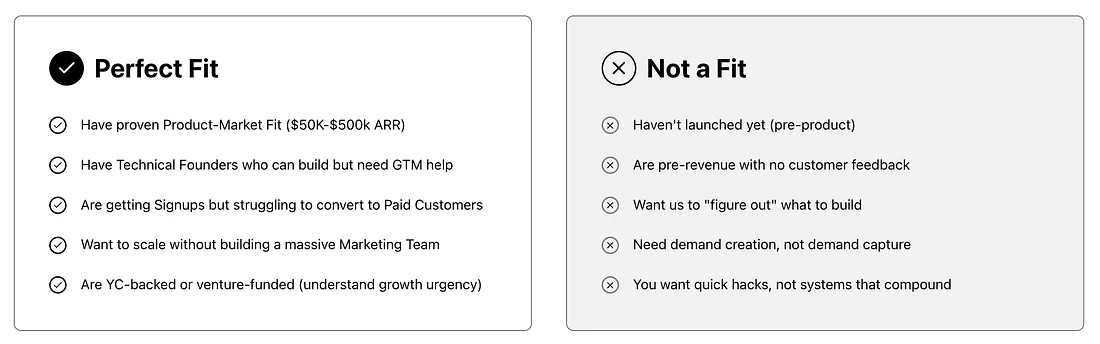
Are you a Good Fit?
We don’t work with everyone. We work best with founders who have a product, traction, and are ready to accelerate growth.
If you’ve built something worth discovering, we’ll help the right people find it.
Book a strategy session
We’ll analyze your product positioning, identify your target audience, and outline a 90-day plan to measurable results. Start your journey by booking a free call.