When Do You Need a Go-to-Market Strategy? GTM Framework for Startup Founders
Fri, Jan 23, 2026

If you're asking "Do I really need a GTM strategy or just better marketing?" - this guide is for you.
Short answer: You need a go-to-market strategy when you're launching a new product, entering a new market, or repositioning something that isn't selling. If you're just tweaking pricing or running a new ad campaign, you don't need a full GTM. You need a marketing plan.
In This GTM Guide, You'll Learn:
- When you actually need a GTM strategy (and when you're overcomplicating things)
- How GTM is different from a marketing strategy (the distinction most founders miss)
- The 5 situations that require a go-to-market strategy
- A practical 5-step GTM framework that works for AI and SaaS startups
- Common GTM mistakes and how to avoid them
- How to know if your GTM is working within 30, 90, and 180 days
95% of new products fail (Harvard Business School). Not because the product was bad, but because founders didn't figure out who they were selling to, how to reach them, or why anyone should care. That's what a GTM strategy solves.
Let me break down exactly when you need one and when you're overcomplicating things.
What is a Go-to-Market Strategy, Really?
A go-to-market (GTM) strategy is your plan to get a product into the hands of people who will pay for it. That's it. It's not a pitch deck. It's not a marketing calendar. It's the answer to four questions:
- Who are you selling to? (Target customer)
- Why should they buy from you? (Value proposition)
- How will you reach them? (Channels and distribution)
- How will you make money? (Pricing and sales model)
If you can't answer these clearly, you don't have a GTM strategy. You have a hope.
Here's the thing most articles won't tell you: a GTM strategy is temporary. It's designed for a specific launch or market entry. Your marketing strategy is ongoing. Your GTM is a focused push to establish yourself somewhere new.
Before we get into when you need a GTM strategy, let's clarify what a go-to-market strategy framework actually looks like. It comes down to four core questions:

The Four Questions Every GTM Strategy Must Answer
5 Situations When You Need a Go-to-Market Strategy

1. You're Launching a Brand New Product
This is the obvious one. You've built something, and now you need to sell it.
But here's where founders mess up: they think the product sells itself. It doesn't. Slack didn't become Slack because it was a great chat app. It became Slack because they targeted developers at tech companies who were already frustrated with email and IRC. They gave it away free, let it spread inside organizations, then converted teams to paid plans.
That's a GTM strategy. Product + target audience + distribution channel + pricing model, all aligned.
When to start: Before you finish building. Seriously. If you're coding features without knowing who needs them, you're building in the dark.
Real example: When Notion launched, they didn't try to compete with Microsoft Word. They targeted individual power users designers, developers, writers. Who wanted a flexible tool. Only after building that base did they go after teams. That sequencing was intentional GTM thinking.
2. You're Entering a New Market
You have a product that works. Now you want to sell it somewhere else new geography, new industry, new customer segment.
This is where companies burn cash fast. What works in the US doesn't automatically work in Germany. What works for enterprise doesn't automatically work for SMBs.
Stripe learned this the hard way. Their expansion into international markets required them to rebuild payment integrations, hire local teams, and adapt to different regulatory environments. Same product, completely different GTM for each market.
The mistake: Assuming you can just translate your website and run the same playbook. You can't. New market = new GTM.
What you need to figure out:
- How does buying behavior differ in this market?
- Who are the local competitors, and how are they positioned?
- What channels actually work here? (LinkedIn might be dominant in the US; in Germany, XING still matters for B2B)
- Do you need local partnerships or can you go direct?
3. You're Repositioning a Product That Isn't Selling
This one hurts, but it's real: sometimes your product is fine, but your positioning is wrong.
You built a project management tool, but you positioned it as "Asana for agencies." Problem is, agencies already use Asana. Or Monday. Or ClickUp. You're fighting a war you can't win.
A repositioning GTM means changing who you're targeting or how you're framing the value without changing the core product.
Example: Mailchimp started as an email marketing tool for small businesses. When they added landing pages, automation, and CRM features, they didn't just update their product page. They repositioned as an "all-in-one marketing platform." Different GTM, same company.
Signs you need to reposition:
- Your conversion rate is low despite good traffic
- Customers say "I didn't know you did that"
- You're losing deals to competitors with worse products
- Your sales cycle is getting longer, not shorter
4. You're Launching a Major New Feature That Changes the Game
Not every feature needs a GTM. But some features are big enough that they change who your customer is or how you compete.
When HubSpot added a free CRM, that wasn't a feature update. That was a strategic move to compete with Salesforce and own the SMB market. It required a full GTM: new positioning, new pricing structure, new onboarding, new sales motions.
The test: Does this feature open up a new customer segment or create a new reason to buy? If yes, you need GTM thinking, not just a product announcement.
5. You're a Startup Testing Product-Market Fit
Here's where it gets interesting. Early-stage startups often think GTM is something you do after you find product-market fit. That's backwards.
Your GTM experiments ARE how you find product-market fit.
You're not trying to scale. You're trying to learn. Which customers respond? Which channels work? What messaging resonates? That's GTM in discovery mode.
What early GTM looks like:
- Testing 3-4 different ICPs (ideal customer profiles) simultaneously
- Running scrappy experiments on LinkedIn, cold email, communities
- Talking to customers weekly, not quarterly
- Iterating on positioning every 2-3 weeks based on what you learn
Rahul Vohra at Superhuman wrote about this. They didn't launch until they had a GTM that worked meaning they could predictably acquire users who loved the product. That took years of iteration.
When You DON'T Need a GTM Strategy

Let's save you some time. You don't need a full GTM strategy for:
Incremental product updates. You added dark mode. Great. That's a changelog entry, not a market strategy.
New marketing campaigns. Running ads on a new platform? That's channel testing, not GTM.
Price changes. Unless you're fundamentally changing your business model (like going from paid to freemium), this is a pricing decision, not a GTM decision.
Hiring a sales team. Sales enablement is part of GTM execution, but hiring people doesn't mean you have a strategy.
Copying a competitor's playbook. If you're just doing what they do, you're not thinking about GTM. You're reacting.
GTM Strategy vs. Marketing Strategy: The Actual Difference
People confuse these constantly. Here's the clearest way I can explain it:

| Aspect | GTM Strategy | Marketing Strategy |
|---|---|---|
| Timeframe | Specific launch or market entry | Ongoing, evolves over years |
| Scope | One product, one market, one moment | All products, all markets, all time |
| Goal | Establish presence, validate fit | Grow awareness, generate demand |
| Changes | Frequently during execution | Slowly, based on performance |
| Ownership | Cross-functional (product, sales, marketing) | Usually marketing team |
A GTM strategy might last 6 months. A marketing strategy should last years, with adjustments.
Think of it like this: your marketing strategy is the house. Your GTM strategy is the construction project to build a new wing.
The GTM Framework That Actually Works
I've seen dozens of GTM frameworks. Most are too complicated. Here's what matters:
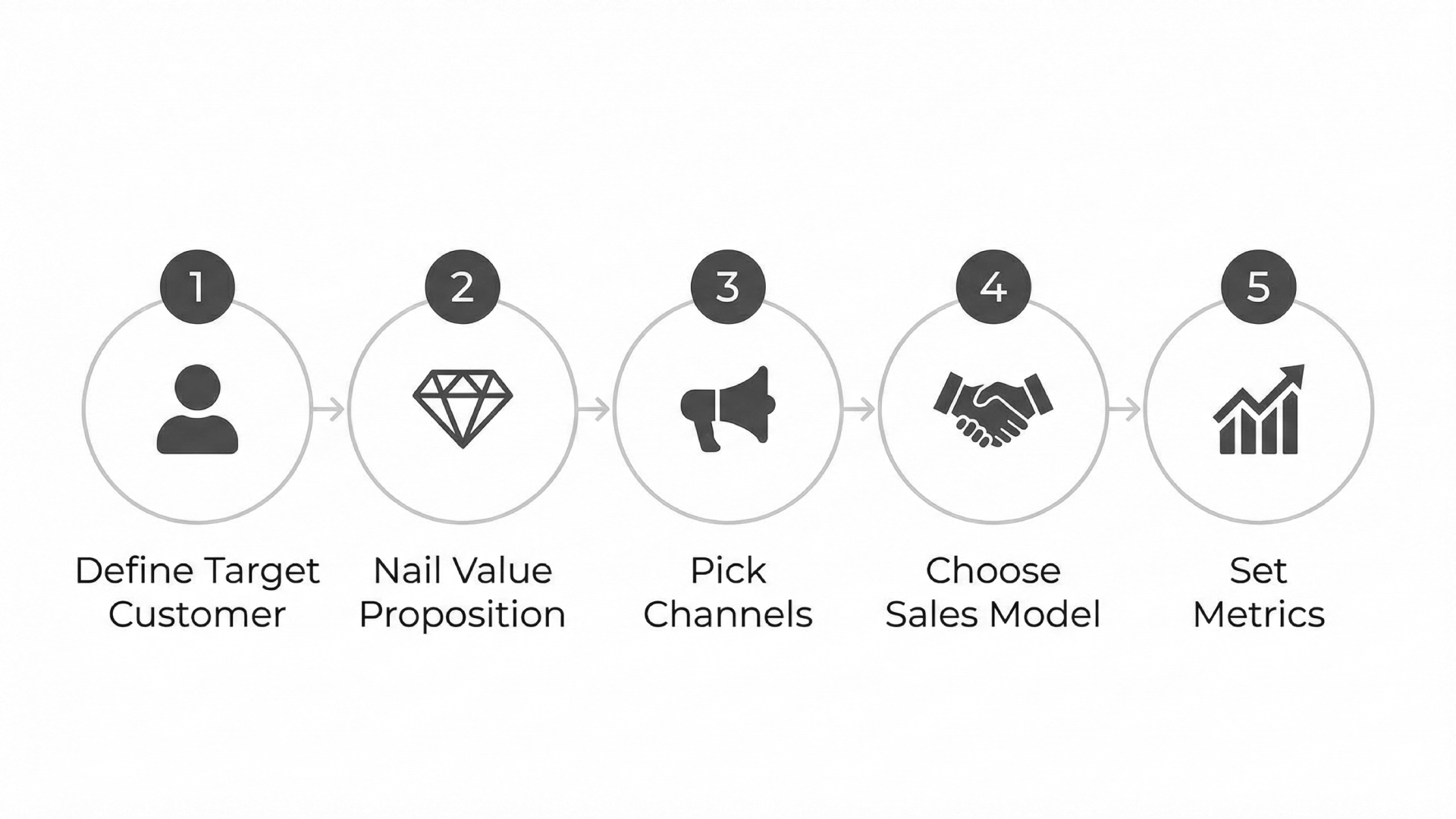
Step 1: Define Your Target Customer (Be Ruthlessly Specific)
"SMBs" is not a target customer. "Series A SaaS companies with 20-50 employees who just hired their first marketing person" is a target customer.
The more specific you are, the easier everything else becomes. Your messaging gets sharper. Your channel choices get clearer. Your sales conversations get faster. (We cover this in depth in our positioning phase - it's the foundation everything else builds on.)
Exercise: Can you list 10 companies that fit your ICP right now? If not, you're not specific enough.
Step 2: Nail Your Value Proposition
Your value proposition isn't a tagline. It's the answer to: "Why should I buy this instead of the alternative?"
Notice I said "alternative," not "competitor." The alternative might be doing nothing. Or using spreadsheets. Or hiring an intern.
Superhuman's value proposition wasn't "email, but better." It was "save 4 hours per week and feel like a productivity god." That's specific. That's emotional. That's sellable.
Test your value prop: Tell it to a potential customer. If they say "okay, how?" you've got something. If they say "hmm, interesting," you don't.
Step 3: Pick Your Channels (Fewer is Better)
First-time founders want to be everywhere. LinkedIn! Twitter! TikTok! Podcasts! Cold email! Events!
Stop. Pick two channels maximum. Master them. Then expand.
For B2B SaaS, the channels that actually work in 2026 (based on HubSpot's State of Marketing report):
- LinkedIn organic + DMs (still underrated for early traction)
- Cold email (if you have a compelling offer and good data)
- Content + SEO (slower, but compounds - see how we've driven 6,000+ GitHub stars through strategic content)
- Community engagement (Reddit, Slack groups, Discord)
- Partnerships (integrations, co-marketing with adjacent tools)
Paid ads come later, after you've validated messaging through organic channels.
Step 4: Choose Your Sales Model
Your product determines your sales model more than you think:

| Price Point | Sales Model | GTM Implication |
|---|---|---|
| < $50/month | Self-serve, product-led | Invest in onboarding, not salespeople |
| $50-500/month | Low-touch sales, SDRs | Inbound + light outbound |
| $500-5K/month | Mid-market sales | AEs with demo-driven process |
| > $5K/month | Enterprise sales | Long cycles, procurement, security reviews |
Trying to enterprise-sell a $30/month product is a waste. Trying to self-serve a $10K product leaves money on the table.
Step 5: Set Your Metrics (Only the Ones That Matter)
Too many metrics = no accountability. Pick 3-5:
For early-stage GTM:
- Activation rate (% of signups who hit key milestone)
- Time to value (how fast users get benefit)
- Customer feedback score (NPS or qualitative)
For scaling GTM:
- Customer acquisition cost (CAC)
- Payback period
- Pipeline velocity
- Win rate by segment
GTM for AI and Developer Tools: What's Different
If you're building for developers or launching an AI product, standard GTM advice often misses the mark. Here's what actually matters:
Developers Hate Being Sold To
Traditional sales tactics backfire. Cold calls? Blocked. Generic LinkedIn DMs? Ignored. Product demos before they've tried it? Insulting.
What works:
- Great documentation. Seriously. Stripe won because their docs were better than competitors' products.
- Free tiers that are actually useful. Not crippled versions. Real utility.
- Community presence. Answer questions on Stack Overflow. Ship examples. Contribute to open source.
- Content that teaches, not pitches. Technical blogs that solve real problems.
AI Products Need Trust Signals
AI has a credibility problem right now. Too many products overpromise and underdeliver. Your GTM needs to address this head-on:
- Show the actual output. Demos, examples, case studies with real results.
- Be honest about limitations. Counterintuitively, this builds trust.
- Offer proof-of-concept periods. Let them test before committing.
- Get technical validation. A CTO testimonial beats a CEO endorsement.
Speed Matters More Than Perfect
The AI market moves fast. A GTM strategy that takes 6 months to execute is probably outdated by month 3.
Build GTM that's:
- Iterative: Weekly experiments, not quarterly planning cycles
- Data-informed: Track what's working in real-time
- Adaptable: Be ready to pivot positioning as the market evolves
Common GTM Mistakes (And How to Avoid Them)

Mistake 1: Building Before Talking
You spent 6 months building, then realized no one wants what you made. Classic.
Fix: Do 20 customer discovery interviews before writing code. Not surveys. Conversations. Learn what they actually struggle with.
Mistake 2: Targeting Everyone
"Anyone who needs project management" is not an ICP. It's a fantasy.
Fix: Start with one specific segment. Expand after you win there.
Mistake 3: Competing on Features
Features are easy to copy. By the time you launch your "unique" feature, three competitors have it too.
Fix: Compete on positioning, speed, experience, or specialization. Not feature checklists.
Mistake 4: Ignoring Existing Behavior
You're not entering an empty market. Customers already have a way of solving this problem (even if it's duct tape and spreadsheets).
Fix: Understand the current solution. Your GTM needs to address why switching is worth the pain.
Mistake 5: Scaling Before Validating
You got 10 customers! Time to hire 5 salespeople and spend $50K on ads!
No. 10 customers isn't validation. It might be luck. It might be friends. It might be a small niche that won't scale.
Fix: Get to 50 paying customers who found you through repeatable channels before scaling anything.
How to Know If Your GTM Is Working
You don't need fancy dashboards. You need honest answers to these questions:

After 30 days:
- Are you getting meetings/demos/signups from your target ICP?
- Is your messaging resonating (qualitative feedback)?
- Are people completing your activation milestone?
After 90 days:
- Can you predict how many customers you'll get next month?
- Are customers actually using the product (not just signing up)?
- Are early customers referring others?
After 6 months:
- Is CAC trending down or staying flat?
- Are you retaining customers past the initial period?
- Have you identified your most profitable segment?
If you're not seeing positive signals within 90 days, something's wrong. Either your ICP is off, your messaging isn't landing, or your product doesn't solve a real problem. Time to iterate.
FAQs About Go-to-Market Strategy
For a focused launch, 2-4 weeks of research and planning. But the plan is just the start. Expect to iterate significantly in the first 90 days based on real-world feedback.
How Varnan Helps AI Companies Nail Their GTM
Look, we wrote this guide because we've seen too many great AI products die in obscurity. Not because the tech was bad. Because the founders couldn't figure out how to get it in front of the right people.
That's what we do at Varnan.
We've built GTM for YC-backed AI companies like Athina AI and Unify. We've driven 6,000+ GitHub stars for developer tools that had zero visibility. We've turned Reddit into a primary growth channel without getting banned. We've helped AI startups go from "nobody knows we exist" to "enterprise customers are reaching out."
Here's how we work:
Phase 1: Positioning (4-6 weeks) We figure out exactly who your customer is and why they should care. Deep market analysis, competitor mapping, founder workshops, and customer interviews. The outcome: your ICP can explain what you do and why it matters in 10 seconds.
Phase 2: Growth Engine (8-12 weeks) We build the content and distribution system that generates qualified leads. Technical content that ranks on Google and gets cited by AI search engines. Founder thought leadership for LinkedIn. Structured launch sequences. The outcome: 3x increase in qualified inbound within 90 days.
Phase 3: Launch & Scale (6-10 weeks) We execute coordinated launches across the channels that matter for developer tools. Design partner recruitment, PR narratives, community loops. The outcome: a repeatable playbook generating $10K+ pipeline per launch.
And we guarantee results. 90 days or we work for free. That's not marketing speak. It's how confident we are in what we do.
Ready to Stop Guessing?
You've built something real. Now it's time to get it in front of the people who need it.
If you're a founder of a high-growth AI startup, we'd love to have a word with you.
Book a free discovery call or reach out directly at paras@varnan.tech.
We'll talk about where you're stuck, what's working, and figure out together if there's a fit. If not, you'll still walk away with a clearer picture of your GTM that's a promise.