Does Short-Form Content Drive User Acquisition?
Mon, Jun 15, 2026
There is a lot of noise right now around short-form content as a growth lever for AI PLG companies, and the reason founders keep talking about it is not because they suddenly care about "content" in the abstract. They care because they have seen real products get pulled into the market through a single strong video. A product that nobody was talking about yesterday starts appearing on feeds, people begin asking for the link in the comments, other creators pick it up, the founder posts a screenshot of the spike, and for a few days the product feels like it has escaped the small corner of the internet it was living in.
So the question is not whether short-form content can create attention. That question has already been answered too many times. The real question for a founder is whether short-form can create the kind of attention that turns into users, customers, GitHub stars, contributors, trial signups, design partners, or whatever acquisition event matters for that specific company.
The answer is yes, but not in the way most teams want it to be true.
Short-form content does not work because the format is magical. It works when the product has something worth showing, the story is framed in a way the right audience can immediately understand, and the distribution comes from a place where that audience already has some trust. If those pieces are missing, a video can still get views, but it will not necessarily move the business.
The Difference Between Attention and Acquisition
A lot of founders confuse visibility with acquisition because the public surface looks similar. A video gets views, the comments move, the founder feels like something is happening, and on the outside it looks like distribution is working. But inside the company, the only thing that really matters is whether the right people did something after watching.
That "something" can look different depending on the product. For a consumer product, it may be paid orders. For a PLG SaaS product, it may be signups. For an open-source developer tool, it may be GitHub stars, forks, contributors, or people joining the community. For a technical infrastructure company, it may be link requests, demo requests, or qualified comments from people who clearly understand the category.
This is why we are careful when we talk about short-form at Varnan. We do not see it as a content activity. We see it as a distribution test. The job is not to make a nice video about the product. The job is to find out whether the market can understand the product fast enough to care, and whether the right audience will take action when that understanding happens.
What made 19,000 developers try Git City in 48 hours?
Few months back, we made a video on Git City. Now this open source product turns every developer's Github profile into a building inside a 3D city and where your contributions decide the height, repositories affect the structure such that your GitHub identity becomes something you can actually see, explore, and share.

Before the video, Git City was already an interesting product, but it was doing around 211 signups per day. That is not nothing, but it was not the kind of distribution curve a product with that much visual novelty could have. The product had the raw material for distribution, but the market had not yet been given the simplest way to understand it. We decided to do a video on the product explaining what it can do and how it gives everyone a sense of entitlement.
So the video did not try to over-explain the product. It did not lead with a long founder story or a technical breakdown. It simply showed what happens when your GitHub profile becomes a city.
The 33-second Reel drove
828,000 views 51,000 likes 97,000 interactions 47,749 weekly visitors on Website 19,000+ new developer signups
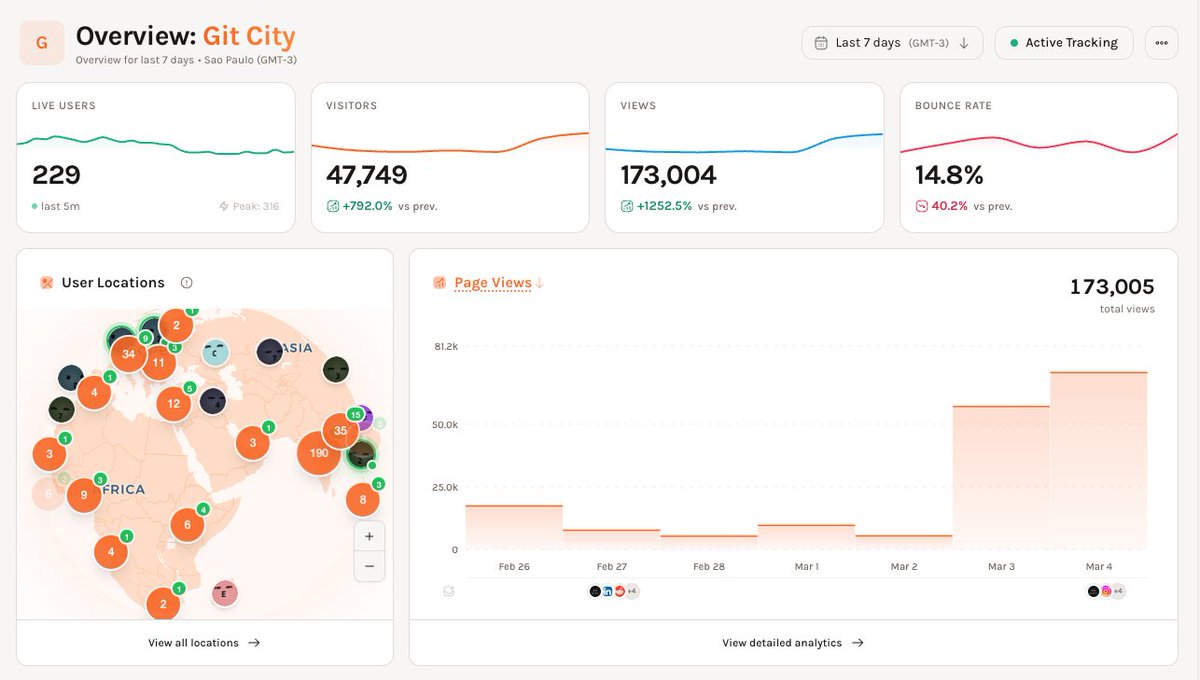
That is not just awareness. That is acquisition created by narrative compression. Git City did not need a louder explanation. It needed the right angle, shown to the right audience, in the right format.
0 to 500+ Sales in a Week for a Comnyang: A Desktop Cat
Comnyang was a very different kind of product. It was not an AI infrastructure tool or a developer platform. It was a pixel cat desktop companion built by an indie maker. The app was charming, finished, and easy to understand once you saw it, but before the video it had zero sales.
We found it on Reddit, cut a short Reel, and posted it through our owned AI and tech channel. There was no formal campaign behind it, no paid promotion plan, and no long-term engagement with the maker before posting. It was simply a case where the product had a very clear emotional and visual hook, and the audience could understand it in a few seconds.
The Reel did:
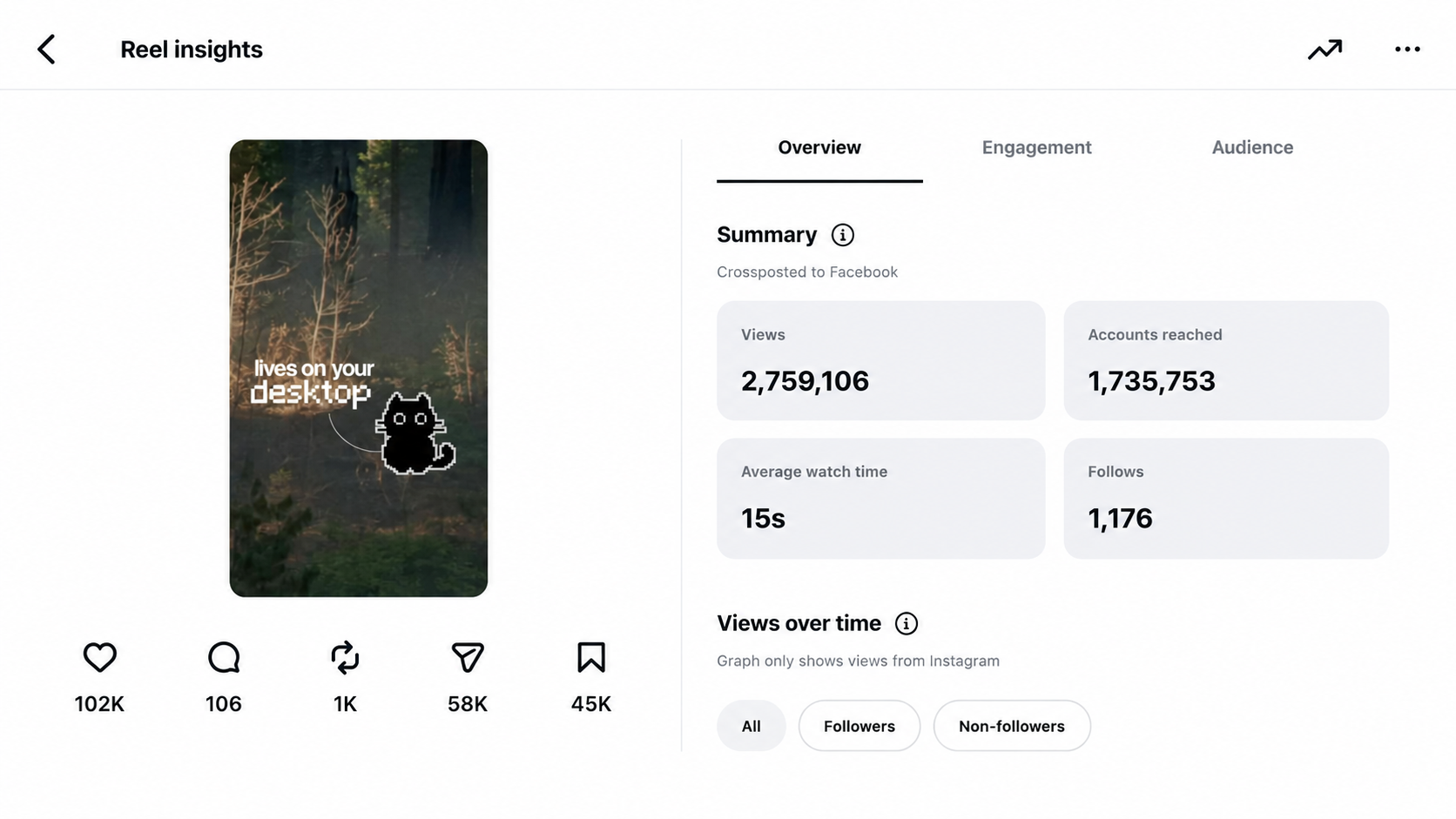
3.3M views with 122K likes, 50K saves and 66k shares Drove 524 paying customers and $2,368 in revenue in a week
Now, the revenue number is not the point we would over-glorify. This was a small indie product, not a large SaaS contract. The more important point is that 524 people saw a product they had never heard of, left the platform, visited the page, and paid. That is a real demand signal, and for a product that had zero sales before the video, it proved something valuable very quickly. Read the full case study.
This is one of the reasons short-form is useful even beyond the immediate spike. It can show whether the product has pull when the framing is right. It can reveal whether people understand the value, whether they save it, whether they share it, whether they ask where to get it, and whether they are willing to take the next step.
This Does Not Mean Every Video Will Work
This is the part most teams need to hear before they spend money on short-form content. Not every video works, even when the product is good. Not every product has the same visual surface area. Not every founder is willing to experiment long enough to find the right angle. And sometimes, the first framing is simply not the one the market responds to.
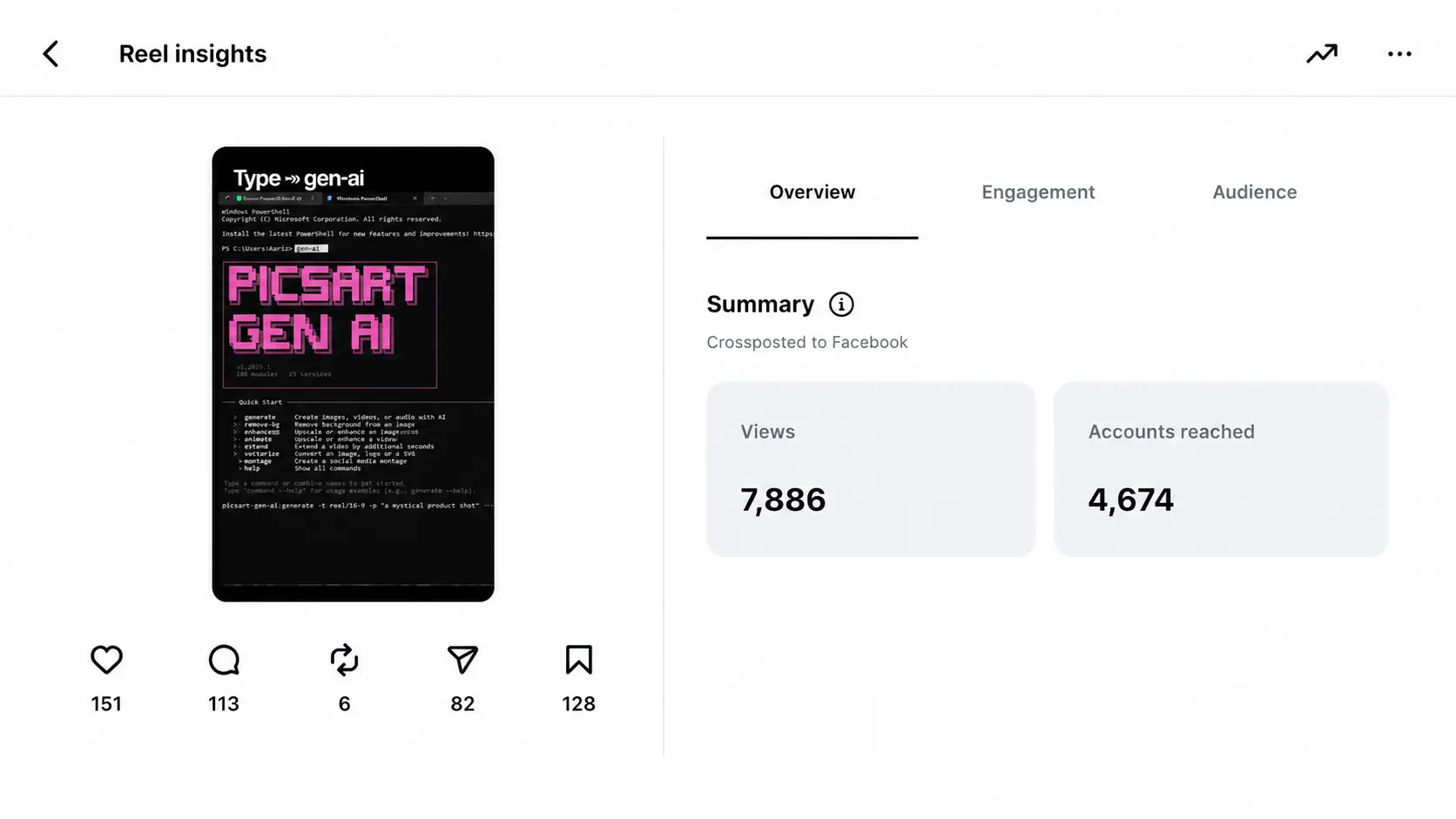
We saw this with a Picsart MCP server video. The product had a real technical angle, and MCP as a category can definitely work in content when the use case is framed well. But the video stayed close to 7.8K views and around 150 likes. It did not become a major acquisition moment.
The bigger lesson was not that MCP content does not work. The lesson was that a one-time engagement gives very little room to learn. When a team wants one post, one angle, and one shot, there is no real system. There is just a bet.
Short-form content becomes much more useful when the team treats it like a structured acquisition experiment. You test different hooks. You test different levels of technical depth. You test whether the audience cares more about the workflow, the outcome, the speed, the cost saving, the novelty, or the credibility behind the product. One video can produce a spike, but repeated learning produces a channel.
What Actually Works for AI and PLG Companies
For AI and PLG companies, the best short-form content usually does one thing very well: it makes the product's value legible before the viewer starts feeling like they are being marketed to.
That sounds simple, but it is where most teams fail. They try to turn the landing page into a video. They talk about the category before showing the product. They explain the company's belief before showing the use case. They add too many features because every feature feels important internally. But the market does not discover products the way teams build them. The market needs one sharp reason to care first.
For Git City, that reason was: your GitHub profile becomes a 3D city.
For Comnyang, it was: a pixel cat lives on your desktop and reacts to you.
For Server Survival, it was not positioned as just a browser game. It was positioned as a way to learn cloud architecture through a playable tower defense environment where traffic, routing, DDoS attacks and infrastructure decisions become part of the game. That positioning helped it cross 1,000+ GitHub stars and build an active contributor base because the right developers understood why it mattered.
For Composio, DigitalOcean, and Undermind, the same principle showed up differently. Composio needed a practical developer-led angle around MCP infrastructure. DigitalOcean Gradient needed a broader AI agents angle for developers and builders. Undermind needed credibility because researchers do not respond to the same type of hype that general tech audiences do.
Where Should Founders Post?
The answer depends on the goal.
If a company needs short-term exposure, existing creators and trusted channels are usually the fastest path. You are not only paying for a video. You are borrowing distribution, audience understanding, and trust that took years to build. This is especially useful when the product is ready, the founder needs market signal quickly, and the internal team does not yet have a large owned channel.
If the company wants compounding growth, one-off creator posts are not enough. Long-term partnerships work better because the creator or distribution partner gets time to understand the product, test multiple angles, and learn what the audience actually responds to. This is where the quality of the relationship matters. The first video may not be the breakout. Sometimes the second or third angle is the one that unlocks the product.
And if the company wants real leverage over time, it should start building its own channels as well. That does not mean hiring someone to post random clips every week. It means building an editorial point of view, showing the product in public, teaching the market how to think about the problem, and slowly turning distribution into an asset the company owns.
For most AI startups, the right answer is not one of these. It is a sequence. Use existing creators for early spikes and fast signal. Use partnerships for repeated experiments. Build owned channels for long-term defensibility.
How Varnan Approaches This
At Varnan, we built Ignition for exactly this reason. A lot of founders know they need distribution, but they do not want a vague content retainer where someone promises posts and impressions. They want to know whether their product can create market movement when it is framed properly and put in front of the right people.
Ignition is structured as a focused 15-day sprint for AI startups that already have something real to show. The idea is to give the company a concentrated version of what structured growth execution looks like: media through our owned AI and tech network, Reddit distribution, and design partner access through our founder and operator network.
It is not positioned as a magic campaign. It is a structured way to test whether the product has a distribution angle, whether the market understands it, and whether the right users are willing to take action.
Because that is what short-form content is at its best. It is not a vanity channel. It is a way to find the part of your product the market is ready to care about.